

If you’re planning to expand organic fertilizer production, you’ve probably discovered that manual operation quickly becomes your biggest challenge. As production grows, feeding, batching, compost turning, granulation, and packaging all require more labor. As a result, product quality becomes harder to control, and operating costs continue to increase. An automatic organic fertilizer making process solves these problems by connecting every production stage into one intelligent manufacturing system. Instead of operating each machine separately, you manage the entire production line through a centralized PLC control system. Consequently, your plant produces fertilizer continuously with higher efficiency, more consistent quality, and lower labor costs.
Why Upgrade to an Automatic Organic Fertilizer Making Process?
As your business expands, simply hiring more workers rarely solves production problems.
How Does an Automatic Organic Fertilizer Making Process Work?
A complete automatic organic fertilizer production line combines intelligent conveying, composting, batching, granulation, drying, screening, and packaging into one continuous manufacturing process. Production Process: Automatic Feeding → Solid-Liquid Separation → Aerobic Composting → Crushing → Automatic Batching → Mixing → Automatic Granulation → Drying → Cooling → Screening → Automatic Packaging → Robot Palletizing
Raw Material Pretreatment and Automatic Composting
First, the process begins with raw material preparation. Whether you process chicken manure, cow dung, pig manure, sheep manure, compost, or agricultural waste, your first objective is to create stable composting conditions. If fresh manure contains more than 70% moisture, a solid-liquid separator reduces the moisture content to approximately 55%–65% before composting. As a result, aerobic microorganisms work more efficiently, and the fermentation cycle becomes shorter. Next, the material enters the automatic composting system. Depending on your site conditions, you can choose windrow composting, groove composting, wheel-type composting, or enclosed fermentation tanks.



During composting, automatic compost turners continuously supply oxygen, redistribute heat, and balance moisture throughout the pile. Meanwhile, maintaining a compost temperature of 55–70°C, a moisture content of 55%–65%, and a carbon-to-nitrogen ratio of approximately 25–30:1 creates ideal fermentation conditions. Under these conditions, microorganisms quickly decompose organic matter and destroy pathogens, weed seeds, and harmful bacteria. Consequently, the composting cycle can often be reduced from 45–60 days to approximately 20–30 days, depending on the raw materials and operating conditions.
Automatic Batching, Mixing, and Granulation
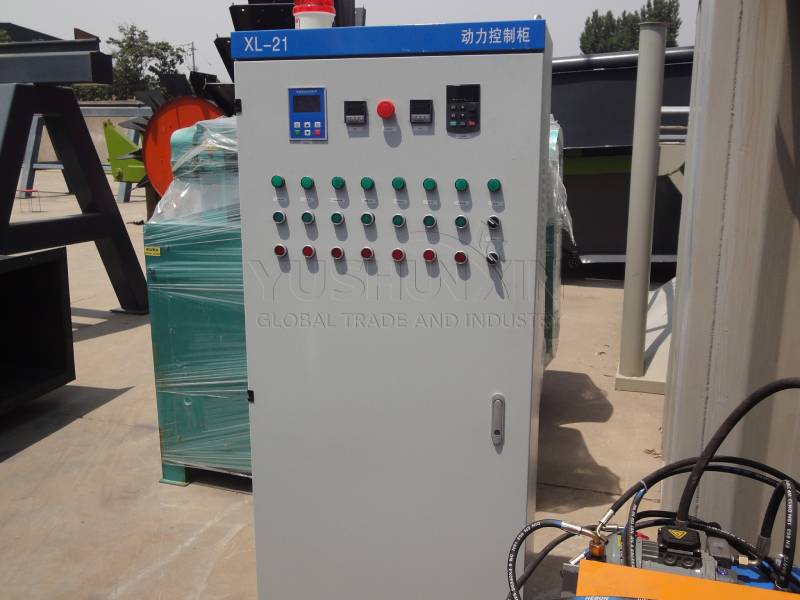
After compost matures, the system conveys the material to a crusher. Next, the crushed material enters the dynamic batching system. Electronic weighing sensors accurately proportion compost, trace elements, and additives according to your fertilizer formula. Then a horizontal mixer blends every ingredient evenly before granulation begins. At this stage, automation becomes even more valuable. Instead of adjusting the feed rate and moisture manually, the PLC system controls material feeding, granulator speed, liquid addition, and material recycling automatically. As a result, the granulation process remains stable, and every batch maintains consistent fertilizer quality.


Automatic Drying, Screening, and Packaging


For wet granulation projects, newly formed fertilizer granules automatically enter a rotary dryer. The PLC system continuously adjusts the drying temperature and material residence time according to the moisture content of the product. After drying, the granules move into a rotary cooler. Next, they enter the screening system. The screening machine sends qualified granules directly to the packaging section. Meanwhile, it automatically returns oversized and undersized particles to the granulator. Therefore, the production line improves raw material utilization and reduces production costs. Finally, the fertilizer enters the automatic packaging line. Electronic weighing systems ensure accurate bag weights before automatic filling and sealing begin. After packaging, the finished bags move directly to a robot palletizer and an optional stretch wrapper. As a result, the packaging process requires very little manual handling.
Throughout the entire production line, enclosed conveyors, bucket elevators, dust collection systems, and PLC control connect every machine into one fully automated manufacturing system.
How Does Automation Improve Fertilizer Production Efficiency?
Automation does much more than replace manual labor. More importantly, it connects every production stage into one coordinated manufacturing process.


Can Automatic Production Help You Meet Environmental Standards?
Absolutely. Today, modern fertilizer plants must achieve both high production efficiency and environmental compliance.


Therefore, if you plan to export fertilizer or equipment to Europe and other international markets, automation makes environmental compliance much easier while strengthening your market competitiveness.
Build Your Automatic Organic Fertilizer Plant with YUSHUNXIN
Every fertilizer project is different. Therefore, the most suitable automatic production line depends on your raw materials, production capacity, fertilizer products, factory layout, and investment goals. Instead of supplying individual machines, YUSHUNXIN designs complete automatic organic fertilizer production solutions tailored to your project.

From raw material pretreatment and intelligent composting to automatic granulation, drying, screening, packaging, and centralized PLC control, every process works together as one coordinated production system. In addition, our engineering team provides customized process design, turnkey installation, commissioning, operator training, and long-term technical support.
Ultimately, you receive much more than a collection of machines. You build a reliable, efficient, and scalable organic fertilizer plant that delivers consistent fertilizer quality, supports future expansion, reduces operating costs, and generates long-term returns on your investment.
Get Your Fertilizer Project Proposal
Share your raw materials, production capacity and project requirements. Our engineering team will provide a suitable fertilizer production solution.


