

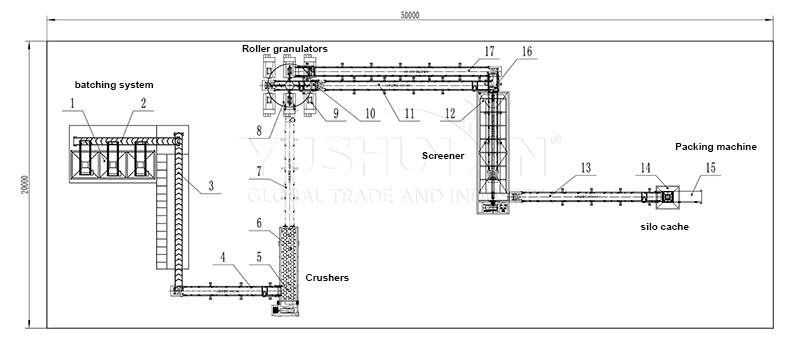
A double roller press granulator converts low-moisture NPK, ammonium sulfate, potassium fertilizers, and mineral powders into 3–10 mm granules. You can choose pillow-shaped, oval, or other compacted granules with different roller moulds. YUSHUNXIN provides SXDG roller granulators with capacities of approximately 1–2 T/H per machine. Besides, we design complete dry fertilizer granulation lines with batching, mixing, crushing, screening, recycling, and packaging equipment.
Can You Granulate NPK, Ammonium Sulfate and Potassium Fertilizer Powders Without Drying?
Yes. Our double roller granulator processes NPK mixtures, ammonium sulfate, ammonium chloride, potassium chloride, potassium sulfate, and magnesium sulfate through dry compaction. For suitable fertilizer powders with 5–10% moisture, the rollers form granules without adding water or steam. Therefore, your line can continue to crushing, screening, and packaging without an additional drying stage.
Raw Material Preparation
| Fertilizer Material | Recommended Preparation |
|---|---|
| Ammonium sulfate | Break up lumps and check powder moisture |
| Potassium chloride / sulfate | Maintain uniform feeding and powder size |
| NPK mixtures | Batch and mix ingredients evenly |
| Magnesium sulfate | Check moisture and compaction properties |
| Phosphate and mineral powders | Crush or grind coarse material before mixing |


For compound fertilizer projects, we can integrate roller compaction into your NPK fertilizer production line. If your formula contains coarse phosphate materials, our rock phosphate processing equipment can support upstream crushing and grinding.
How Can We Prevent Weak Granules, Roller Sticking and Feeding Blockages?
We help you address these problems through suitable roller settings, mould selection, and stable material feeding.
Improve Granule Strength
If your granules break easily, the roller gap, pressure, or material binding properties may need adjustment. Our engineers can recommend suitable compaction settings according to your fertilizer formula. Besides, the feeding system helps distribute powder consistently between the rollers. For projects targeting 15–20 N granule hardness, we can evaluate the necessary settings through sample testing. This helps you select a configuration that meets your required granule strength.


Prevent Roller Sticking



Excess moisture can cause fertilizer powder to stick inside the roller mould cavities. YUSHUNXIN can recommend appropriate feed moisture and roller settings for your formulation. We can also customize the mould cavities to improve material release. Regular cleaning removes accumulated powder and helps keep the roller surfaces clear.
Avoid Feeding Blockages
Fine powders can bridge inside the hopper and interrupt feeding. Our engineers can select a suitable hopper outlet and feeding mechanism to maintain material flow. For powders that bridge easily, we can add an anti-bridging device above the rollers. This helps your line avoid repeated feeding interruptions and inconsistent compaction.


Can You Produce 3–10 mm Fertilizer Granules in Different Shapes?
Yes. Our SXDG roller granulators support 3–10 mm granules, with different mould cavities for your target shape.
Roller Mould Shapes
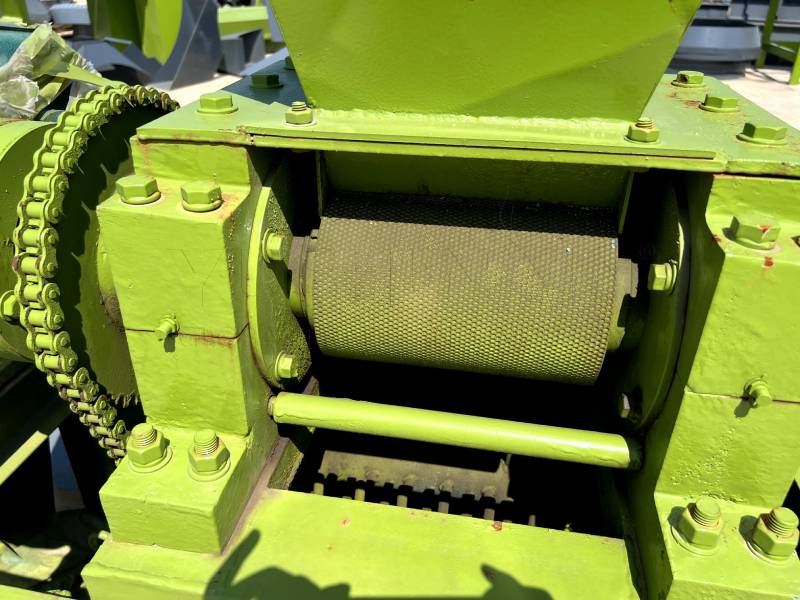
You can choose pillow-shaped, oval, flattened, tablet-like, or other compacted granules. YUSHUNXIN can customize the mould cavity dimensions according to your fertilizer specifications. For example, pillow-shaped cavities form compact granules with rounded edges. Tablet-like moulds offer another option when your product needs a flatter profile. The mould design determines the initial compact shape, while downstream equipment helps control the final size.

Control the Finished Granule Size

For 3–5 mm fertilizer granules, we can match the roller moulds with suitable crushing and screening equipment. A different cavity specification can support larger granules within the 3–10 mm range. After compaction, the screener separates your required size fraction before packaging. This allows you to produce different granule specifications by adjusting the mould and downstream sizing arrangement.
How Many Tons per Hour Can a Double Roller Press Granulator Produce?
YUSHUNXIN offers three SXDG models covering approximately 0.8–2 T/H per machine.
SXDG Granulator Specifications
| Model | Capacity | Motor Power | Roller Size | Granule Size |
|---|---|---|---|---|
| SXDG-1 T | 0.8–1.5 T/H | 11 kW | 151 × 220 mm | 3–10 mm |
| SXDG-1.5 T | 1.5 T/H | 18.5 kW | 151 × 300 mm | 3–10 mm |
| SXDG-2 T | 2 T/H | 22 kW | 186 × 300 mm | 3–10 mm |
For smaller projects, we can select the SXDG-1T or SXDG-1.5T according to your production target. The SXDG-2T provides a 2 T/H machine configuration for larger material throughput.
3–5 T/H Dry Granulation Configuration
For 3–5 T/H production, our engineers can combine multiple roller granulators with suitable feeding and material distribution equipment. We also match the mixer, crusher, screener, and return conveyors to the combined output. Our fertilizer granulation plant page offers additional production-line configurations for different capacities.


How Can You Extend Roller Die Life and Reduce Replacement Costs?
Roller sheets experience repeated pressure and abrasive contact during granulation. Selecting suitable materials and maintaining the roller surfaces helps reduce replacement frequency.
Roller Sheet Materials
YUSHUNXIN offers 20CrMoTi and 4Cr13 roller-sheet options for different equipment configurations. For abrasive mineral fertilizers, YUSHUNXIN offers 20CrMoTi alloy steel roller sheets to improve wear resistance. Consistent feeding also helps limit uneven pressure across the roller surfaces. Besides, you should keep hard foreign objects out of the feeding system to reduce accidental cavity damage.

Roller Maintenance and Replacement
You can inspect roller cavities, surface wear, alignment, and material buildup during scheduled maintenance. Worn cavities may change granule shape and reduce compaction consistency. When wear affects your finished granules, replacement roller sheets help restore the required mould profile. Our company supplies SXDG roller sheets and related spare parts. We can also recommend replacement components for your maintenance inventory.
How Can You Separate 3–10 mm Granules and Recycle Fine Powder?
We can connect crushing, rotary screening, and return conveyors after the double roller granulator. This arrangement separates qualified fertilizer granules and returns suitable off-size material for further processing.
Crushing and Rotary Screening
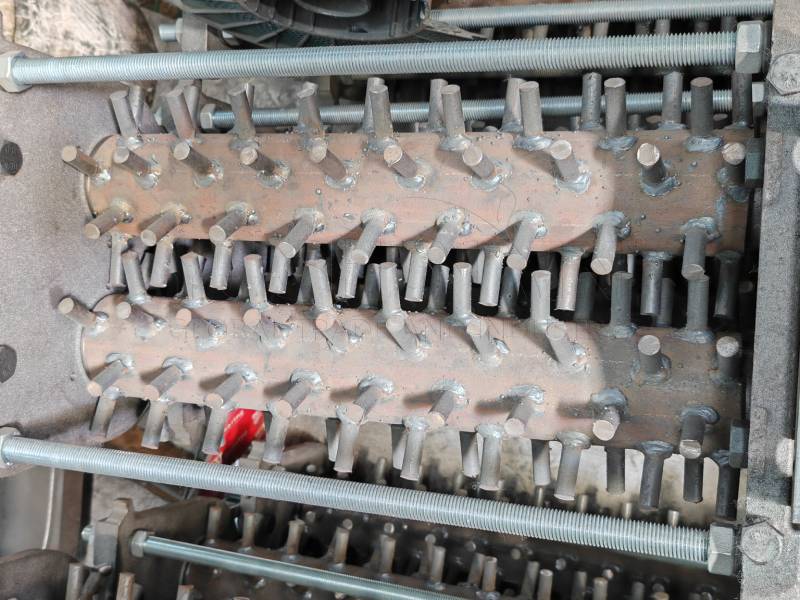
First, the crusher breaks oversized or connected compacts into smaller particles. Next, the rotary screener separates granules through different screening sections. For a 3–5 mm product, we can use nominal separation points around 3 mm and 5 mm.
| Granule Size | Processing Route |
|---|---|
| Below 3 mm | Return suitable fine powder for further compaction |
| 3–5 mm | Send qualified granules toward packaging |
| Above 5 mm | Crush oversized material and screen again |
Fine Powder and Dust Recovery
The return conveyor carries suitable fine material back to the mixing or roller feeding section. Meanwhile, the crusher reduces oversized material before another screening cycle. For dusty fertilizers, we can add collection points around crushing, screening, and conveyor transfers. This helps your factory recover usable material and limit dust losses. You can explore our fertilizer dry granulation method for more complete dry-processing arrangements.
How Much Does a Dry Fertilizer Granulation Line Cost for 1–5 T/H Production?
YUSHUNXIN offers complete dry fertilizer granulation solutions for NPK, potassium fertilizer, and mineral powders.
1–5 T/H Dry Granulation Line Price
| Production Capacity | Estimated Price (USD) | Main Equipment |
|---|---|---|
| 1–2 T/H | $20,000–50,000 | Batching, mixing, roller granulation, crushing, screening, conveying, basic bagging |
| 3–5 T/H | $50,000–120,000 | Multiple roller granulators, batching, mixing, crushing, screening, recycling, conveying, bagging |
The selected roller models, machine quantities, and packaging automation determine your project quotation. For finished fertilizer handling, we can connect suitable fertilizer bagging equipment with an automatic palletizing machine.
We also support equipment selection, factory layout design, installation guidance, and after-sales service. If you plan to build or upgrade a dry fertilizer granulation line, please feel free to contact YUSHUNXIN. Our team can recommend a solution according to your raw materials, target capacity, and finished granule specifications.


