

Your livestock manure wastewater is not only a disposal problem. It can become a pressure point in your farm, biogas plant, or fertilizer project if solids, sludge, odor, and water cannot move through the process smoothly. Our turnkey Livestock Wastewater Treatment System can help you separate coarse solids first, reduce suspended solids through fine separation, dewater sludge after treatment, and create a clearer route toward wastewater discharge requirements.
What Makes Livestock Wastewater Difficult to Treat?
Does your wastewater carry too much manure fiber, suspended solids, bedding residue, or feed waste? Then the problem often starts before biological treatment. Raw manure wastewater contains a high amount of organic solids and moisture, which makes direct discharge difficult and increases the pressure on the following treatment stages. For pig slurry, dairy manure wastewater, poultry manure wastewater, and biogas slurry projects, reducing the solid load early helps you operate the wastewater treatment process more smoothly.
A common mistake is treating manure solid-liquid separation and sludge dewatering as the same step. They are different. The first stage removes coarse manure solids from wastewater. The later stage handles fine sludge generated after settling, flocculation, or biological treatment.
If you want stable operation, it helps to separate these tasks clearly. That is why a turnkey Livestock Wastewater Treatment System often combines solid-liquid separation, high-frequency vibrating separation, and screw press sludge dewatering.
How Does Solid Separation Reduce Your Wastewater Load?
Solid-liquid Separator for Coarse Solid Removal
When your manure wastewater contains large amounts of solid particles, you can start with solid-liquid separator to reduce the heavy solid load before further treatment. This step is suitable for pig manure wastewater, dairy manure wastewater, poultry manure wastewater, and other livestock wastewater with high solid content. After this separation, the solid fraction becomes easier to collect and handle, while the liquid stream continues to the next treatment stage. The separated solid moisture can generally reach around 30%–40%.

High-frequency Vibrating Separator for Fine Solid Reduction
After coarse separation, your wastewater may still contain fine suspended solids. This is where a high-frequency vibrating separator helps reduce the remaining solid load before sedimentation, flocculation, or sludge treatment. With a 2400 × 1200 mm screen, 150 mesh screen density, and 0.3 mm filtration density, the equipment can process 30–50 m³/h of raw material. The solid interception rate can reach 95%, while the discharged solid moisture remains around 55%–65%, and the liquid phase contains about 5% solids.
What does this mean for your project? It means you can reduce suspended solids before the wastewater enters the following treatment stages, helping your downstream process handle a cleaner liquid stream.
Why Is Screw Press Sludge Dewatering Needed After Separation?


What Equipment Can Be Included in a Turnkey Manure Wastewater Treatment System?


How Much Does a Livestock Wastewater Treatment System Cost?
Are you asking for one separator, or are you planning a complete treatment line? The cost changes a lot.
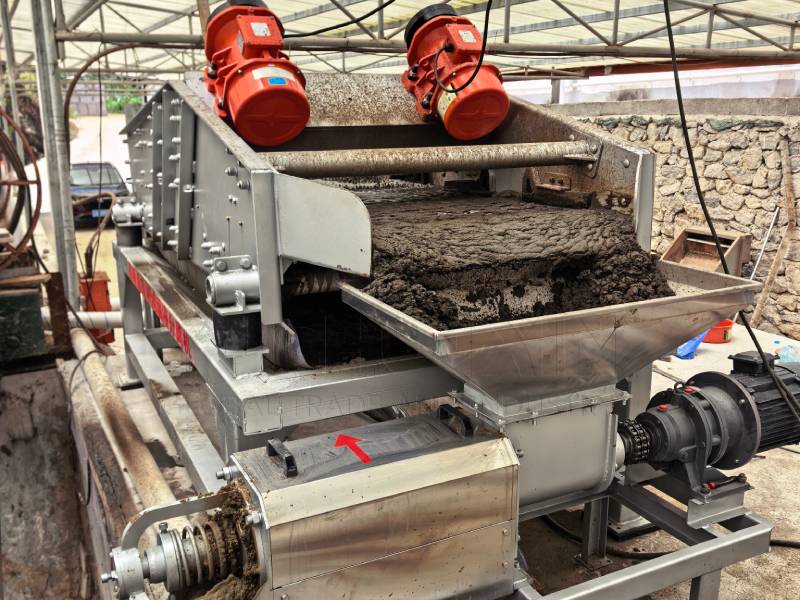
A high-frequency vibrating separator can have a reference price of about 8,000 USD for the discussed configuration. A complete Livestock Wastewater Treatment System may include pumps, tanks, solid-liquid separation, high-frequency vibrating separation, flocculation, screw press sludge dewatering, electrical control, and other wastewater treatment equipment.
Build Your Livestock Wastewater Treatment Solution
If your project handles large volumes of pig slurry, dairy wastewater, poultry manure wastewater, or biogas slurry, one machine may not give enough control.
YUSHUNXIN can design a turnkey Livestock Wastewater Treatment System for your project by combining solid-liquid separation, high-frequency vibrating separation, and screw press sludge dewatering according to your wastewater source and treatment requirements.
Get Your Fertilizer Project Proposal
Share your raw materials, production capacity and project requirements. Our engineering team will provide a suitable fertilizer production solution.


