

The organic waste aerobic composting process is the foundation of modern organic fertilizer production and sustainable waste recycling. Compared with traditional waste disposal, aerobic composting reduces odors, destroys pathogens, lowers environmental pollution, and improves resource utilization. Therefore, whether you operate a livestock farm, a composting facility, or an organic fertilizer plant, choosing the right composting system is the first step toward efficient manure recycling and profitable fertilizer production.
Which Organic Wastes Can Be Processed Through Aerobic Composting?
Aerobic composting can process many kinds of biodegradable organic materials.


How Does the Organic Waste Aerobic Composting Process Work?
A complete aerobic composting system connects raw material preparation, moisture adjustment, fermentation, curing, and screening into one continuous process. Process: Raw Material Preparation → Solid-Liquid Separation → Moisture Adjustment → Mixing → Aerobic Composting → Mechanical Turning → Compost Curing → Screening → Finished Compost
Raw Material Preparation and Moisture Adjustment
First, prepare the raw materials. Fresh livestock manure usually contains 70–90% moisture, which limits oxygen flow and slows fermentation. If needed, a solid-liquid separator reduces moisture to about 60–70%. Then, straw, sawdust, rice husks, or other bulking agents are mixed in to adjust moisture to 55–65% and balance the C/N ratio to 25:1–30:1.Aerobic Fermentation and Compost Turning
Next, the prepared material enters windrows, composting grooves, or enclosed fermentation tanks. Compost turning equipment supplies oxygen, loosens the pile, redistributes heat, and removes excess moisture. Under stable conditions, the temperature rises to 55–70°C, helping destroy pathogens, parasite eggs, weed seeds, and harmful bacteria.Compost Curing and Screening
After active fermentation, the compost enters the curing stage and becomes fully mature. Finally, a rotary screening machine removes oversized materials. The finished compost can be packaged as powder organic fertilizer or sent to a granulation line for higher-value fertilizer granules.Top 3 Aerobic Composting Systems for your Organic Fertilizer Production project
The most suitable composting system depends on your production capacity, available land, environmental requirements, automation level, and investment budget.
Windrow Composting System
Windrow composting is the most economical solution for livestock farms, composting sites, and small to medium organic fertilizer plants with sufficient outdoor space.
This system typically combines a solid-liquid separator with a Moving Type Compost Turner, Crawler Compost Turner, or Fully Hydraulic Crawler Compost Turner. Since compost piles are formed directly on the ground, no concrete fermentation channels are required, significantly reducing civil construction costs while allowing flexible expansion simply by increasing the number or length of windrows.


For smaller projects, the Moving Type Compost Turner provides a simple, cost-effective solution. Medium-capacity plants generally select the Crawler Compost Turner because of its greater turning depth and higher processing capacity. Large commercial composting facilities often prefer the Fully Hydraulic Crawler Compost Turner, which combines hydraulic lifting, powerful turning performance, and continuous operation to reduce labor requirements.
Groove Composting System
For commercial fertilizer plants requiring standardized production, higher automation, and improved environmental management, groove composting is often the preferred solution.

After raw material preparation, compost is transferred into concrete fermentation channels where a Groove Type Compost Turner continuously aerates and mixes the material. When equipped with a transfer carriage, one machine can serve multiple fermentation grooves, increasing equipment utilization while reducing investment costs.
For larger industrial fertilizer factories, the Chain Plate Compost Turner provides even higher productivity. Its deep-turning structure supports continuous feeding, continuous fermentation, and continuous discharge, making it highly suitable for automated fertilizer plants. Combined with PLC control, automatic traveling systems, and optional spraying devices, the entire composting process becomes highly efficient and easy to manage.


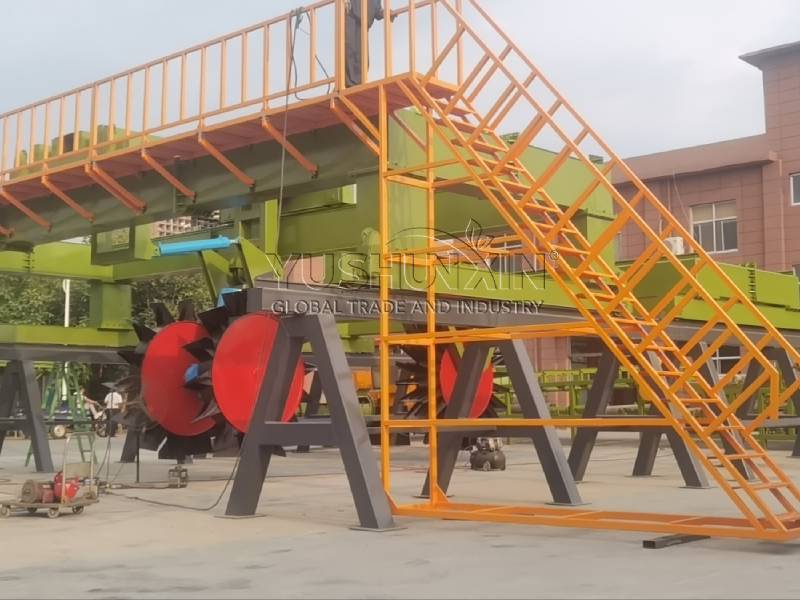
For ultra-large centralized composting facilities, Wheel Type Compost Turners and Double Wheel Compost Turners provide maximum productivity. Their large-span structures can process fermentation grooves up to 30 meters wide with turning depths reaching 3 meters, making them ideal for municipal organic waste recycling centers and large livestock farms processing hundreds or even thousands of tons of manure every day.
In-Vessel Composting System
For projects with limited land availability or strict environmental regulations, enclosed fermentation systems provide the highest level of process control.
Horizontal Fermentation Tanks and Vertical Fermentation Tanks integrate automatic aeration, intelligent temperature monitoring, moisture regulation, mechanical mixing, and deodorization into one enclosed system. Compared with open composting, in-vessel systems require much less installation space, effectively eliminate odor emissions, prevent rainwater intrusion, and maintain stable fermentation conditions throughout the entire process.


Depending on raw material characteristics, primary fermentation can usually be completed within 7–15 days, making these systems particularly suitable for livestock farms located near residential areas and modern organic fertilizer factories requiring clean, standardized production.
How Does Our Composting System Improve Composting Efficiency?
High-quality compost depends on maintaining the proper balance of moisture, oxygen, temperature, and porosity throughout the fermentation process. Instead of relying on manual experience, YUSHUNXIN uses integrated equipment and intelligent process control to maintain these conditions automatically.


Ready to Build an Efficient Aerobic Composting System?
Every composting project is different. Therefore, the best aerobic composting solution depends on your raw materials, daily processing capacity, available land, environmental requirements, and long-term production goals.
Customized Composting Solutions
Instead of recommending a standard machine, YUSHUNXIN designs complete composting systems that match your project.
First, our engineers evaluate your raw materials, moisture content, production capacity, and site conditions. Next, we recommend the most suitable composting technology and equipment configuration. Depending on your requirements, the solution may include solid-liquid separation, compost turners, fermentation tanks, crushing, screening, granulation, drying, cooling, packaging, and centralized PLC control.

As a result, every stage works together as one efficient production system instead of a collection of individual machines.
Complete Engineering Support
In addition to equipment manufacturing, we provide complete engineering support throughout your project.

Our services include process design, equipment selection, factory layout planning, installation guidance, commissioning, operator training, and long-term technical support. Meanwhile, our engineers continue to optimize your production process as your business expands. This approach helps you improve efficiency while protecting your long-term investment.
Turn Organic Waste into Commercial Value
Whether you plan to recycle livestock manure, build an industrial composting center, or establish a complete organic fertilizer production plant, we can help you develop a practical and scalable solution.


With the right composting technology and professional engineering support, you can transform manure and other organic waste into profitable fertilizer products while building a cleaner, more efficient, and more sustainable fertilizer business.


